iBoysoft DiskGeeker for Windows Online Help - BitLokcer Encryption & Management
Overview of BitLokcer Encryption & Management
"BitLocker Encryption & Management" of iBoysoft DiskGeeker for Windows allows users to use BitLocker drive encryption to encrypt NTFS, FAT32, or exFAT partitions and manage them on Windows 11/10/8.1/8/7 Home editions and Windows 7 Professional edition.
It includes two primary functions: "Encrypt normal partition" and "Partition management."
The Encrypt normal partition feature enables users to encrypt NTFS, FAT32, and exFAT partitions with BitLocker encryption. When the encryption completes, the drive will be unlocked automatically, and users can access the partition to read and write data without any BitLocker-relevant third-party software.
The Partition management function enables you to centrally manage all BitLocker-encrypted partitions and non-encrypted partitions.
You can:
- Open, lock, or unlock a partition
- Resume the interrupted BitLocker encryption process for a partition or roll back the partition to the original state.
- Change the password of a BitLocker-encrypted drive
- View and back up the recovery key of a BitLocker-encrypted drive
- Turn off BitLocker encryption of a drive
- Bind BitLocker unlock of a drive only on this computer
A new user is allowed to BitLocker-encrypt a partition less than 16GB and access BitLocker drives for free.
How to Encrypt a Partition with BitLocker in Windows Home Editions?
This drive manager brings back the unavailable full BitLocker drive encryption function in Windows 11/10/8.1/8/7 Home editions and Windows 7 Professional edition.
With it, you can even encrypt the system partition (C drive) for personal data protection.
Step 1: Click "Encrypt" next to the partition you want to encrypt.
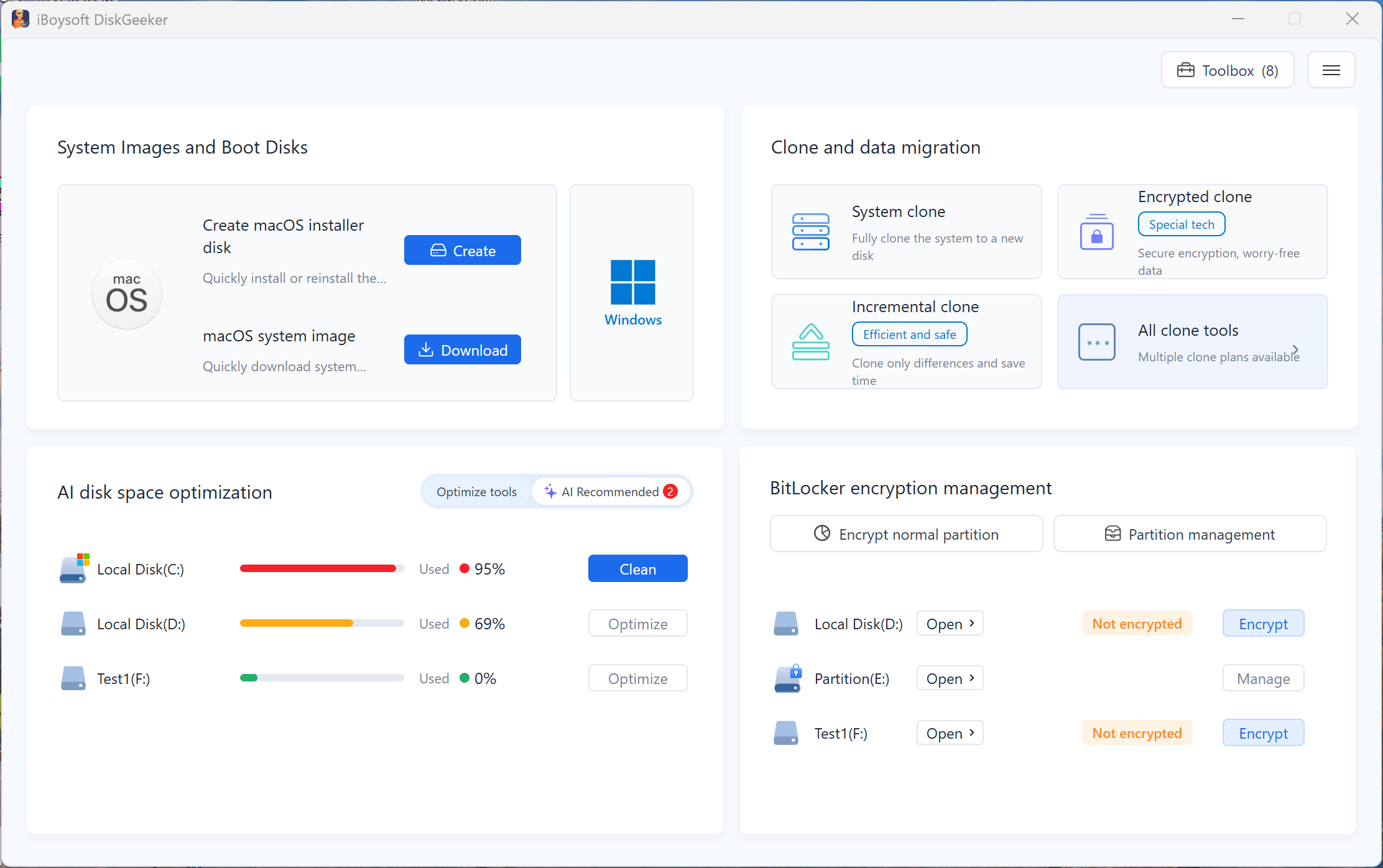
You can only encrypt an NTFS, exFAT, or FAT32 partition. If you encrypt a partition that is not formatted as the NTFS, exFAT, or FAT32 file system, you'll be shown an error message saying "Partition type not supported."
Step 2: Enter a password, re-enter it for confirmation, and click "Encrypt" to proceed.
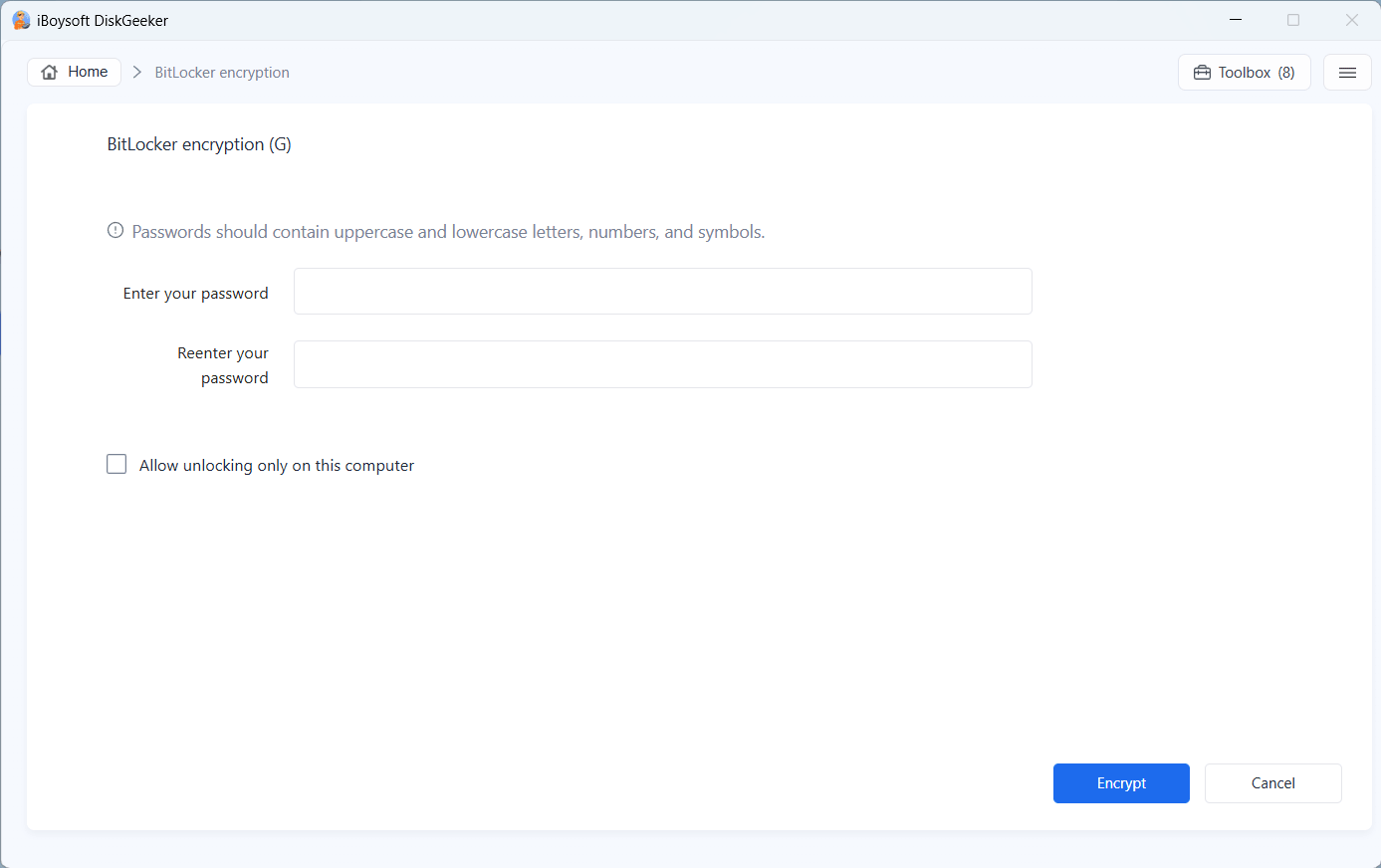
• The password is used to unlock the BitLocker-encrypted partition, so please preserve it well and securely.
• Your password should be between 6 and 47 characters and contain at least one letter or figure.
• The password you enter twice should be the same, or you'll be notified that "The password you entered don't match."
Step 3: A recovery key will be generated by this software; please save it well and click "Next."
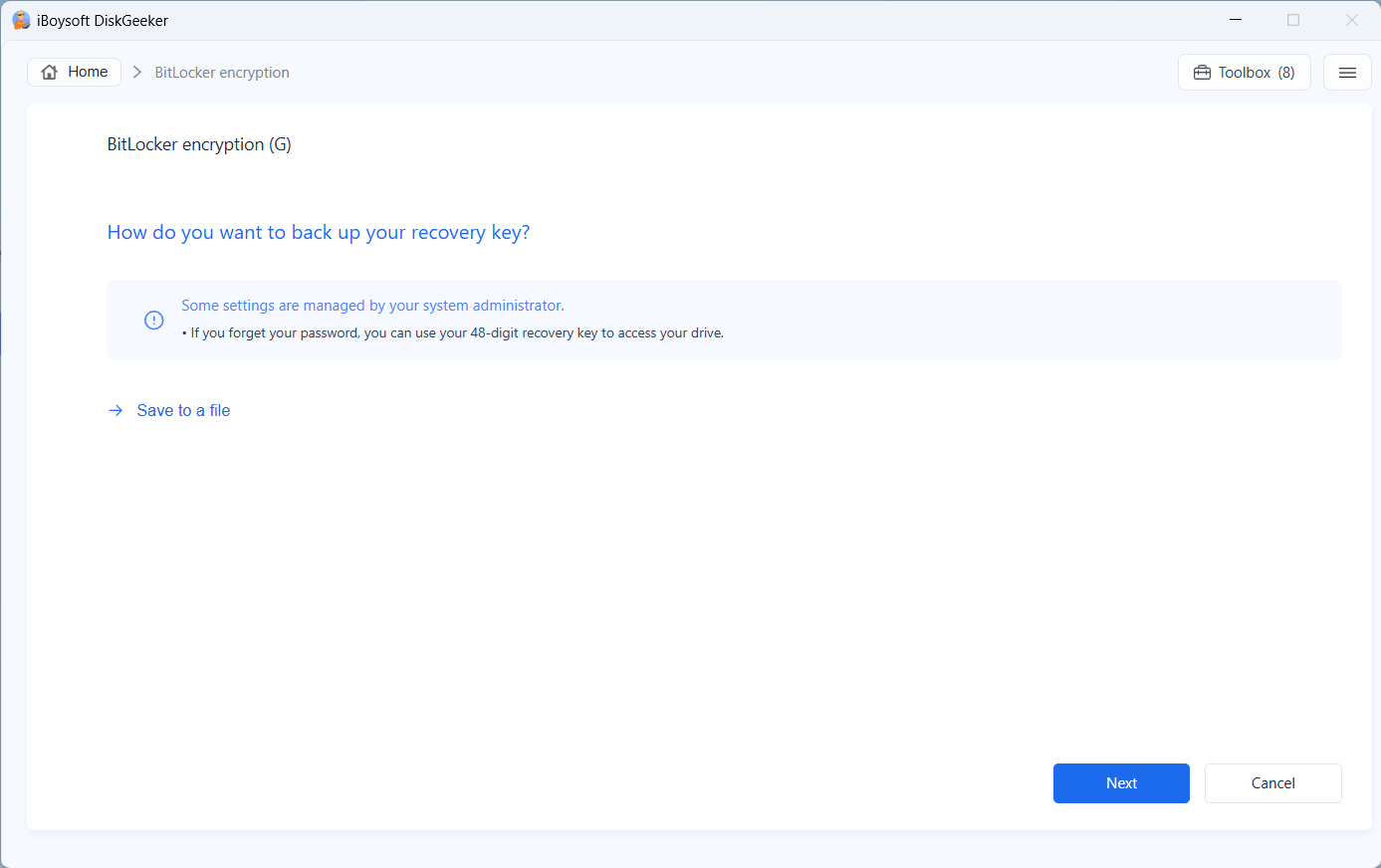
• The recovery key is used to unlock the BitLocker-encrypted partitions if you forget your password; you have to save it well before the encryption process starts. You should save the recovery key to a preferred partition, except the one you want to encrypt. Then, remember its file name and file directory for your further access.
• If there is no available partition to save the recovery key, it will be placed in the software installation directory by default.
• If you lose the password and the recovery key both, you then cannot open the BitLocker-encrypted partition.
Step 4: Click "Start encrypting" to confirm your encryption action.
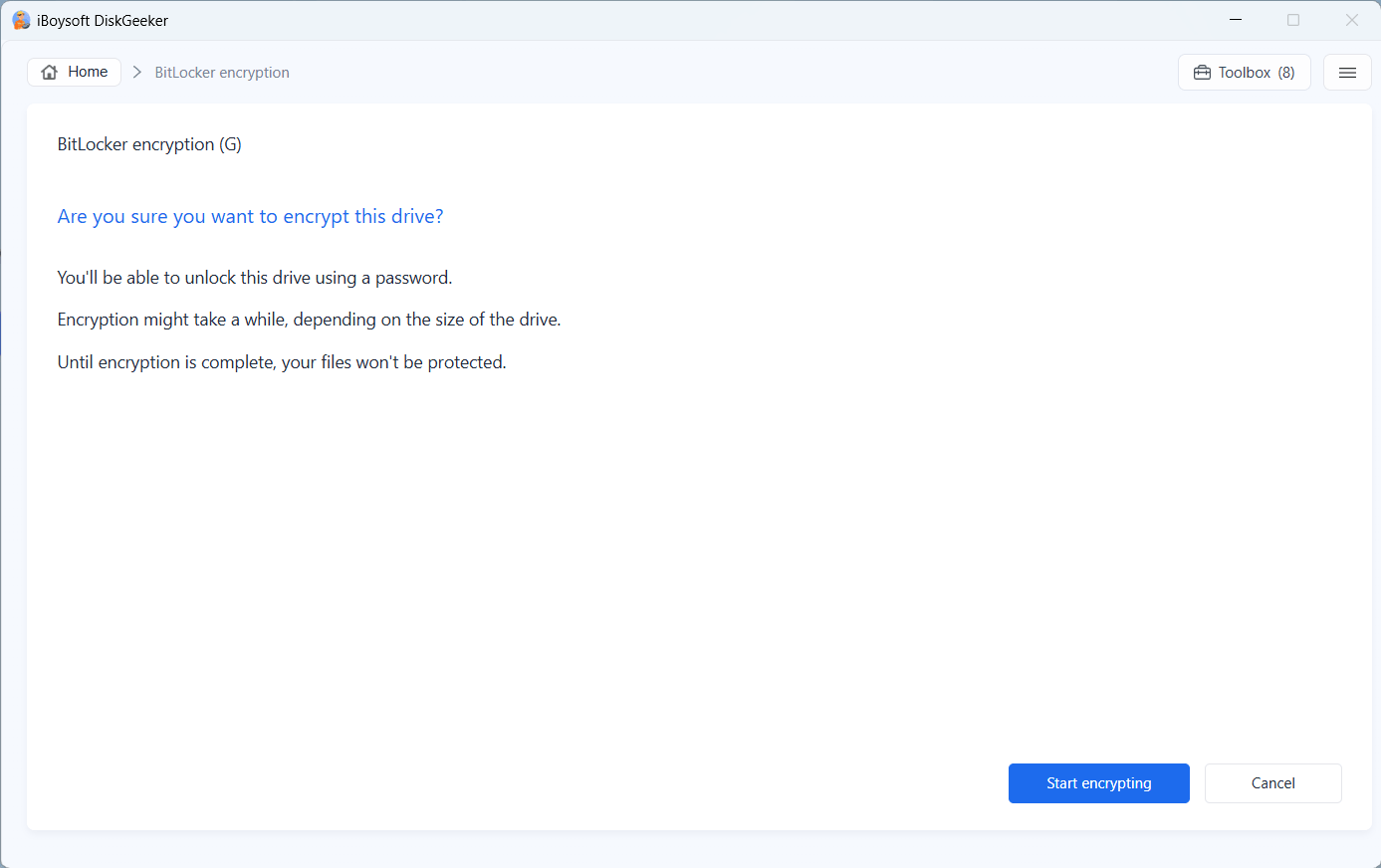
• Once the encryption begins, you cannot cancel it.
• The target partition will be locked before encryption. This is to prevent data inconsistency resulting in encryption errors. If the software can't lock the partition, the encryption won't proceed. You can contact: [email protected].
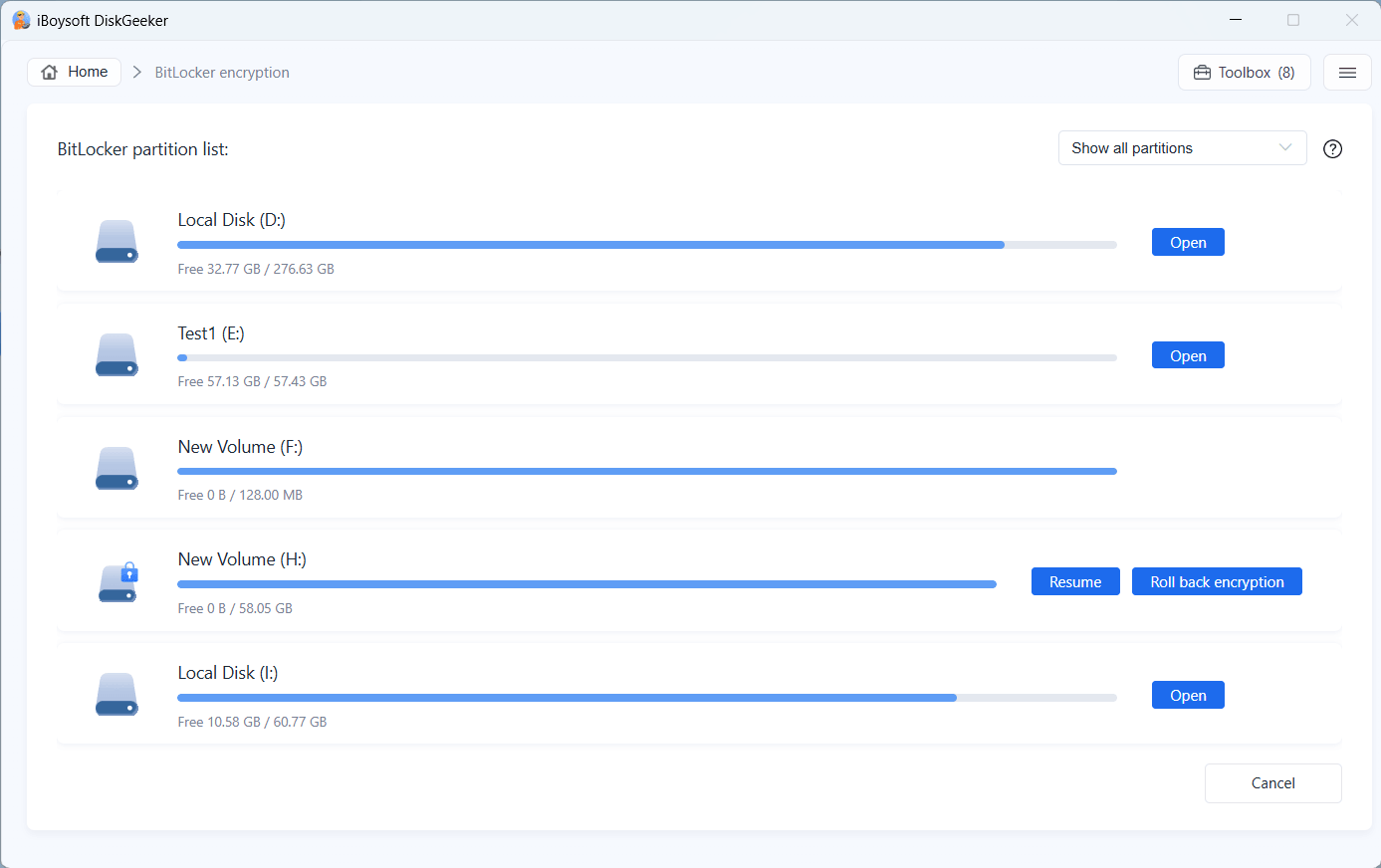
• If your PC shuts down or the target disk is unsafely ejected, you can relaunch iBoysoft DiskGeeker for Windows and resume the encryption or roll back the drive to the original state:
#1. Click "Partition management."
#2. Click "Resume" next to the partition to continue encryption. Or, click "Rollback" to restore your partition to the original state.
Step 5: Wait for the encryption to end.
Once the partition encryption finishes, the partition will be automatically unlocked for you to read and write without a password.
How to Manage BitLocker-encrypted and Other Partitions?
"Partition management" allows users to quickly manage and access the existing BitLocker-encrypted and other partitions.
Step 1: Click "Partition management."
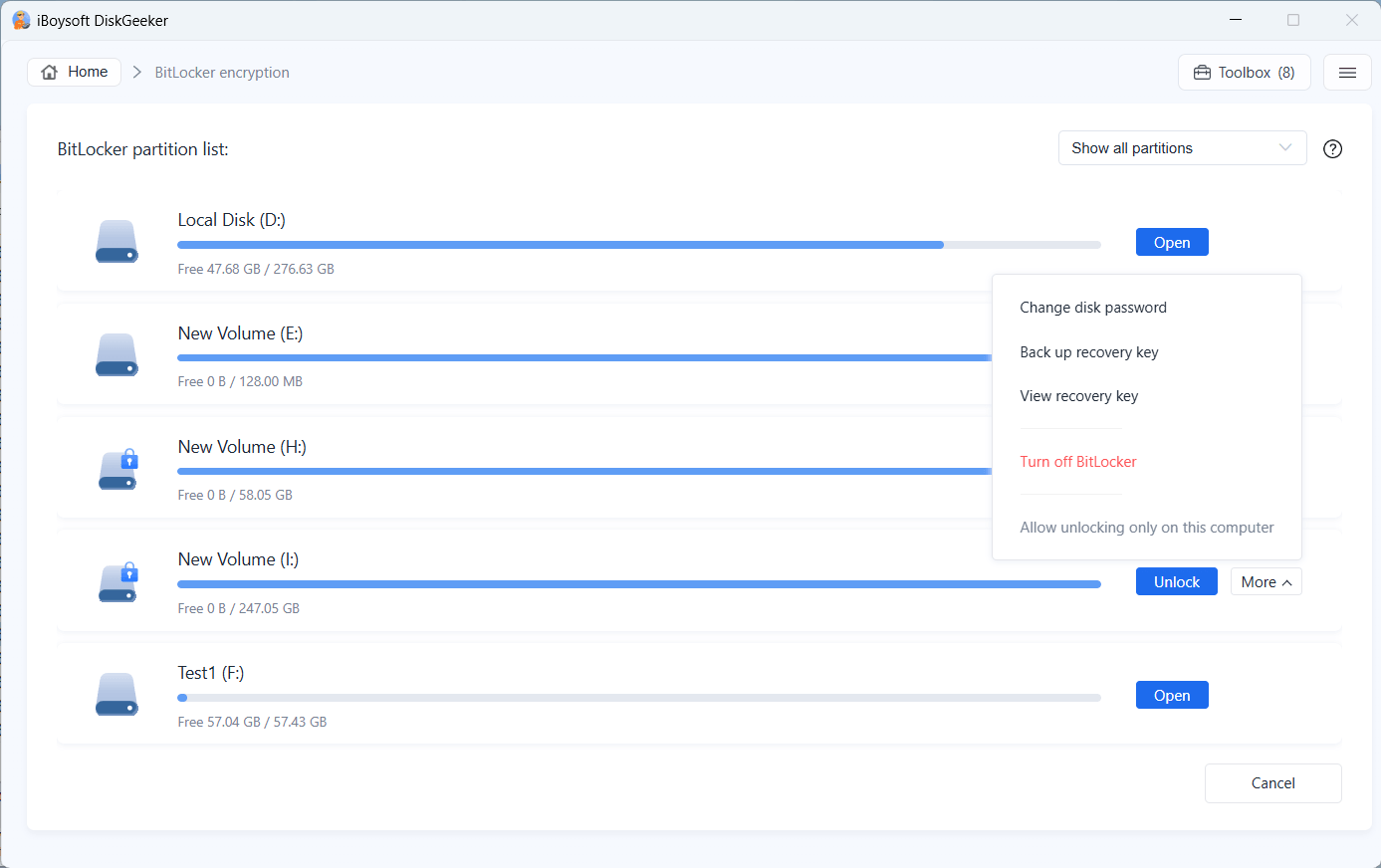
Step 2: You can click the top right box and select to "Show all partitions," "Only show encrypted partitions," or "Only show unencrypted partitions."
Step 3: Complete the following BitLocker-encrypted management tasks based on your preferences or needs:
Resume: Resume an uncompleted BitLocker encryption.
Roll back encryption: Restore the partition to the original state when the encryption is interrupted.
Lock: Lock a BitLocker encrypted partition to make it inaccessible.
Unlock: Enter the BitLocker password to unlock the partition and make it in an accessible state.
Open: Directly open a partition on your PC.
Change disk password: Change the password of the BitLocker-encrypted drive. Notably,you should unlock the drive first with the BitLocker password or recovery key before using this feature.
Back up recovery key: Back up the BitLocker-encrypted drive's recovery key. You should unlock the drive with the BitLocker password first.
View recovery key: View and copy the BitLocker-encrypted drive's recovery key. You should unlock the drive first.
Turn off BitLocker: Disable BitLocker encryption for the target BitLocker-encrypted drive. You should unlock the drive first.
Allow unlocking only on this computer: The BitLocker-encrypted drive can only be unlocked on this computer with password or recovery key.
FAQ:
1. Can I open my BitLocker-encrypted drive without password?
You can open the BitLocker-encrypted drive without password if you have the recovery key, just go to the directory where you save it and copy and paste it to unlock the encrypted drive.
2. Can I BitLocker-encrypt my Ext4-formatted drive with iBoysoft DiskGeeker for Windows?
No, you can't BitLocker-encrypt the Ext4-formatted drive since the BitLocker-encryption feature only supports a drive formatted as the NTFS, FAT32, and exFAT file systems.
3. The encryption process of my hard disk terminates due to a PC power failure; can I continue the encryption or have I must start all over again?
iBoysoft DiskGeeker for Windows allows users to resume and rollback a drive, you can choose to Resume to finish the uncomplete the encryption or Rollback the drive to the original state when it is unencrypted based on your preference.
4. If I unlock my encrypted drive, will the drive be decrypted?
No, when you unlock your encrypted drive with the recovery key or password, you put it into a readable and writable state, but your hard drive won't be decrypted.